
Most conversations about AI and risk assessment focus on industrial settings: motion capture in warehouses, automated ergonomic scoring for manual handling tasks, real-time alerts on factory floors. That framing leaves a significant gap. The majority of UK knowledge workers spend their days at a desk, and work-related musculoskeletal disorders (MSDs) among desk-based employees account for 511,000 cases and 7.1 million lost working days per year.
The problem is not that employers lack a legal framework. The Health and Safety (Display Screen Equipment) Regulations 1992 require employers to assess DSE workstations, reduce identified risks, and provide information and training. The problem is that most organisations fulfil this obligation with an annual self-assessment form. The form gets completed. The risk data rarely gets used.
AI-powered DSE risk assessment changes what that process can produce. This article explains how it works, what it can and cannot do, and what organisations with large desk-based or hybrid workforces should look for when evaluating a solution.
Why the Annual DSE Form Is Not Enough
A standard DSE self-assessment asks employees to report on their workstation setup, equipment, and any discomfort they are experiencing. Completed once a year, it produces a snapshot. The snapshot may be accurate on the day it is taken. It is rarely accurate six months later, particularly for employees who have moved home, changed their working pattern, or developed a new symptom since the last review.
The limitations compound when you look at what happens after the form is submitted. In many organisations, responses are reviewed manually, flagged issues are logged on a spreadsheet, and follow-up depends on a small team chasing individuals across multiple sites. For an employer with 2,000 desk-based workers, that is not a risk management process. It is an administrative exercise.
The HSE's own statistics point to the scale of what is being missed. Among the causes of work-related MSDs, repetitive keyboard work and awkward working positions are consistently cited alongside manual handling. These are desk-based risks. They affect people who sit at screens for most of their working day, often in setups that have never been properly reviewed.
Three specific weaknesses define the traditional approach:
- Coverage gaps: Remote and hybrid workers may complete a home assessment once and never be followed up. Workstation changes, new equipment, and changing health needs go unrecorded.
- Timing problems: Annual assessments miss the moment when guidance would actually be useful. A 2025 meta-analysis of 24 randomised controlled trials covering more than 4,000 DSE workers found that ergonomic guidance produces minimal long-term behaviour change unless it is delivered when a symptom is present.
- Data that cannot be acted on: Completion percentages tell a duty holder whether the process has been followed. They do not identify which teams carry the highest risk, which individuals need follow-up, or whether previous recommendations have been applied.
These are not problems that a better form can fix. They require a different kind of process.
What AI-Powered DSE Risk Assessment Actually Does
AI-powered DSE risk assessment uses machine learning and automated reasoning to do things a static form cannot: identify patterns across populations, personalise guidance to individual circumstances, flag emerging risk before it becomes absence, and manage follow-up without manual intervention.
The term is used loosely in the market, so it is worth being specific about what a well-built system does at each stage of the process.
Assessment and risk identification
A well-designed AI-guided DSE assessment goes beyond asking employees to tick boxes. It uses adaptive questioning, adjusting the assessment path based on how someone answers earlier questions. An employee who reports neck pain is asked different follow-up questions than one who reports no discomfort. The result is a more accurate picture of individual risk, not a generic checklist result.
At a population level, AI can identify patterns that a human reviewer would not spot in a spreadsheet. Which teams have the highest proportion of employees reporting upper limb discomfort? Which office locations are generating repeated equipment requests? Which job roles show consistently elevated risk scores? These are the questions that allow an H&S team to prioritise intervention rather than simply record compliance.
Personalised guidance at scale
The value of personalisation in ergonomic guidance is well established. A 2026 study published in Ergonomics validated AI-based models for predicting MSK risk in office workers across nine anatomical regions, finding that simplified, interpretable tools were feasible for practical ergonomic screening at scale. The key insight is that AI can deliver targeted, individual recommendations, based on a person's specific workstation, reported symptoms, and working pattern, without requiring a one-to-one assessment by a trained assessor.
This matters for hybrid organisations. An employee working three days from a spare bedroom and two days at a hot desk has a fundamentally different risk profile from a colleague in a fixed office setup. Generic guidance serves neither of them well.
Automated follow-up and compliance management
The administrative burden of DSE compliance sits primarily in what happens after the assessment: chasing completions, reviewing flagged responses, assigning corrective actions, and tracking whether those actions have been taken. AI can automate a substantial portion of this workflow.
A capable platform will:
- Send automated reminders to employees who have not completed their assessment or whose assessment is due for renewal
- Flag high-risk responses for human review, rather than requiring a duty holder to read every submission
- Generate and track corrective actions with assigned responsibility and deadlines
- Produce audit-ready reporting that shows completion rates, outstanding actions, and risk distribution across the organisation
The result is that a small H&S team can maintain effective oversight of a large, distributed workforce without the process collapsing into spreadsheet management.
What AI cannot do
It is important to be clear about the limits. AI-powered DSE assessment is a decision-support tool. It can identify risk indicators, prioritise who needs follow-up, and deliver consistent guidance at scale. It cannot replace the judgement of a competent person when a complex case requires it, and it does not provide clinical diagnosis or treatment.
The most credible systems are designed to escalate appropriately: directing employees with significant or persistent symptoms to occupational health or other professional support, rather than attempting to resolve everything within the platform.
Why Desk-Based Workers Are a Distinct Risk Population
Much of the existing discussion about AI and ergonomic risk assessment focuses on physically demanding work: manufacturing, logistics, healthcare. The tools developed for those settings typically involve wearable sensors, video-based posture analysis for manual tasks, or motion capture for repetitive physical operations.
Desk-based workers present a different kind of risk profile. Their exposures are less dramatic but no less consequential: sustained static posture, prolonged screen time, repetitive keyboard and mouse use, and workstation setups that vary significantly between home and office environments. The HSE's 2024/25 statistics show that upper limb and neck disorders account for 41% of all work-related MSD cases, and back disorders for a further 43%. These are the regions most affected by desk-based work.
The hybrid shift has made this harder to manage. Before widespread remote working, an employer could conduct a physical workstation assessment for every employee in a single building. That is no longer feasible. Employees now work from kitchen tables, spare bedrooms, coffee shops, and hot desks, often within the same week. The DSE Regulations apply to employees who work from home on a regular basis, which means the compliance obligation has expanded significantly while the practical tools available to most H&S teams have not.
The result is a coverage problem. Organisations that rely on a single annual self-assessment are almost certainly missing a substantial portion of their actual risk exposure. Employees who have changed their home setup, developed new symptoms, or moved between working locations since their last assessment are effectively invisible to the risk management process.
The compliance exercise stays intact. What changes is that it starts producing usable information rather than a completion percentage.
AI-powered assessment is particularly well suited to this population because it can be deployed digitally at scale, updated when an employee's circumstances change, and used to identify risk patterns across a distributed workforce without requiring physical site visits.
What to Look for in an AI-Powered DSE Assessment Solution
Not all platforms that use the word "AI" in their description are doing the same thing. Some apply basic automation to an existing questionnaire workflow. Others use genuinely adaptive assessment logic, population-level risk analysis, and personalised guidance delivery. The distinction matters when you are evaluating a solution for a large organisation.
The following criteria are worth examining in any evaluation:
Assessment quality:Does the platform use adaptive questioning that adjusts based on individual responses, or is it a fixed-format questionnaire?
Personalisation: Does the guidance delivered to employees reflect their specific workstation, symptoms, and working pattern?
Population-level reporting: Can duty holders view risk distribution across teams, locations, and job roles, not just individual completion rates?
Corrective action management: Are follow-up actions tracked within the platform, with assigned responsibility and audit trail?
Hybrid and remote coverage: Does the platform support home working assessments on the same basis as office assessments?
Escalation pathways: Does the system identify when an employee needs referral to occupational health or other professional support, and does it facilitate that?
Integration: Can the platform connect with existing HR, LMS, or occupational health systems to reduce administrative duplication?
The question of evidence
A reasonable buyer should ask what evidence a provider can offer that their platform produces better health outcomes, not just better completion rates. Completion is a compliance measure. It is a starting point, not an endpoint.
The evidence base for AI-driven ergonomic assessment in office settings is developing. A 2026 study in the Ergonomics journal found that AI models showed moderate but consistent performance for neck and lower back risk prediction across independent datasets, supporting their use as screening tools for prioritising assessment and monitoring. The authors were careful to note that these tools should be viewed as decision-support systems rather than definitive classifiers, and that local validation remains important.
That is a reasonable framing for any employer evaluating a platform: AI can improve the quality and coverage of your risk assessment process. It cannot guarantee outcomes. Providers who claim otherwise are overstating what the evidence supports.
Implementation considerations
Enterprise deployment of a DSE assessment platform involves more than selecting the right tool. Practical questions that affect whether a rollout succeeds include:
- Employee communication: How will the assessment be introduced, and what messaging will drive completion without creating anxiety?
- IT and data handling: What are the data residency, security, and integration requirements? Does the platform support SSO and existing provisioning workflows?
- Governance: Who owns the process? What happens when a flagged assessment requires follow-up, and who is responsible for ensuring that follow-up occurs?
- Review cycle: How often will assessments be refreshed, and what triggers a new assessment outside the standard cycle (a change of role, a new home setup, a reported symptom)?
These questions are not obstacles to implementation. They are the substance of it. A provider who cannot engage with them in detail is unlikely to deliver a process that works at scale.
Connecting Assessment to Ongoing MSK Support
A DSE assessment identifies a need. The employer's obligation does not end there. Under the DSE Regulations, employers are required to reduce risks identified through assessment and to provide appropriate information and training. What that means in practice is that assessment is the beginning of a process, not the conclusion of it.
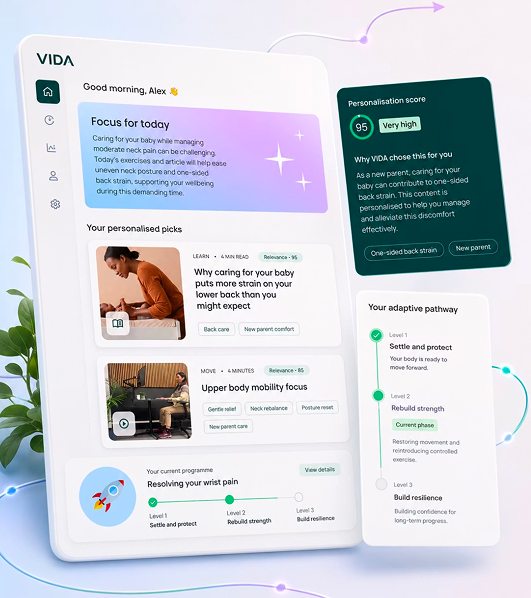
The most effective AI-powered platforms treat assessment as the entry point to ongoing support. When an employee completes an assessment and reports neck pain, the useful response is not a PDF of generic stretching advice. It is personalised guidance that reflects their specific workstation setup, a prompt to review their equipment, and a pathway to further support if the problem persists.
This is where AI-powered DSE assessment connects to the broader question of MSK health at work. The HSE's guidance on DSE is explicit that assessment should lead to action. The data from a well-designed platform, including symptom trends, equipment requests, and engagement with guidance, can also help employers understand where MSK risk is concentrated and make more informed decisions about where to invest in prevention.
For H&S and HR teams evaluating their options, the practical question is whether the platform they are considering treats compliance as a destination or as a starting point. A completed assessment that produces no usable follow-up is a missed opportunity. An assessment that connects to personalised support, tracks corrective actions, and identifies emerging risk across the workforce is something different: a tool that justifies the investment in operational terms.
To see how VIDA's AI-guided DSE assessment works in practice for organisations with desk-based and hybrid teams, or to explore the broader DSE assessment software capabilities, get in touch to arrange a demonstration.