
Key takeaways
- Workplace musculoskeletal health services cover assessment, prevention, routing into treatment and the reporting an employer needs to see whether any of it worked.
- Hybrid working is concentrated in exactly the population enterprise employers are trying to retain. 28% of working adults in Great Britain hybrid worked between January and March 2025, rising to 41% of those with a degree and 45% of those earning £50,000 or more (ONS, 2025).
- Musculoskeletal disorders affected 511,000 workers in Great Britain in 2024/25 and accounted for 7.1 million lost working days (HSE, 2025).
- 64% of assessed workers report discomfort in the back, neck or shoulder at the point of their VIDA assessment (Vitrue Health platform data, more than 20,000 desk-based workers).
- Employer duties do not stop at the office door. Home workers are covered by the same DSE Regulations as office-based staff.
- The thing that distinguishes a programme from a perk is whether it can route the minority who need clinical care, and show you what happened to them.
What are workplace musculoskeletal health services
Workplace musculoskeletal health services are the assessments, guidance, clinical routing and reporting an employer uses to reduce MSK risk across a workforce. In a desk-based organisation they cover four jobs: finding out who is at risk, helping people correct the causes they can control themselves, getting the minority who need clinical care into it quickly, and measuring whether the first three are working.
Most employee wellness programmes stop after the first two. That is the gap that matters, because MSK problems do not resolve on their own and the cost of a late intervention is an order of magnitude higher than an early one.
What hybrid working actually changed
The common framing is that home setups are worse than office ones. Sometimes true, but it is not the structural change.
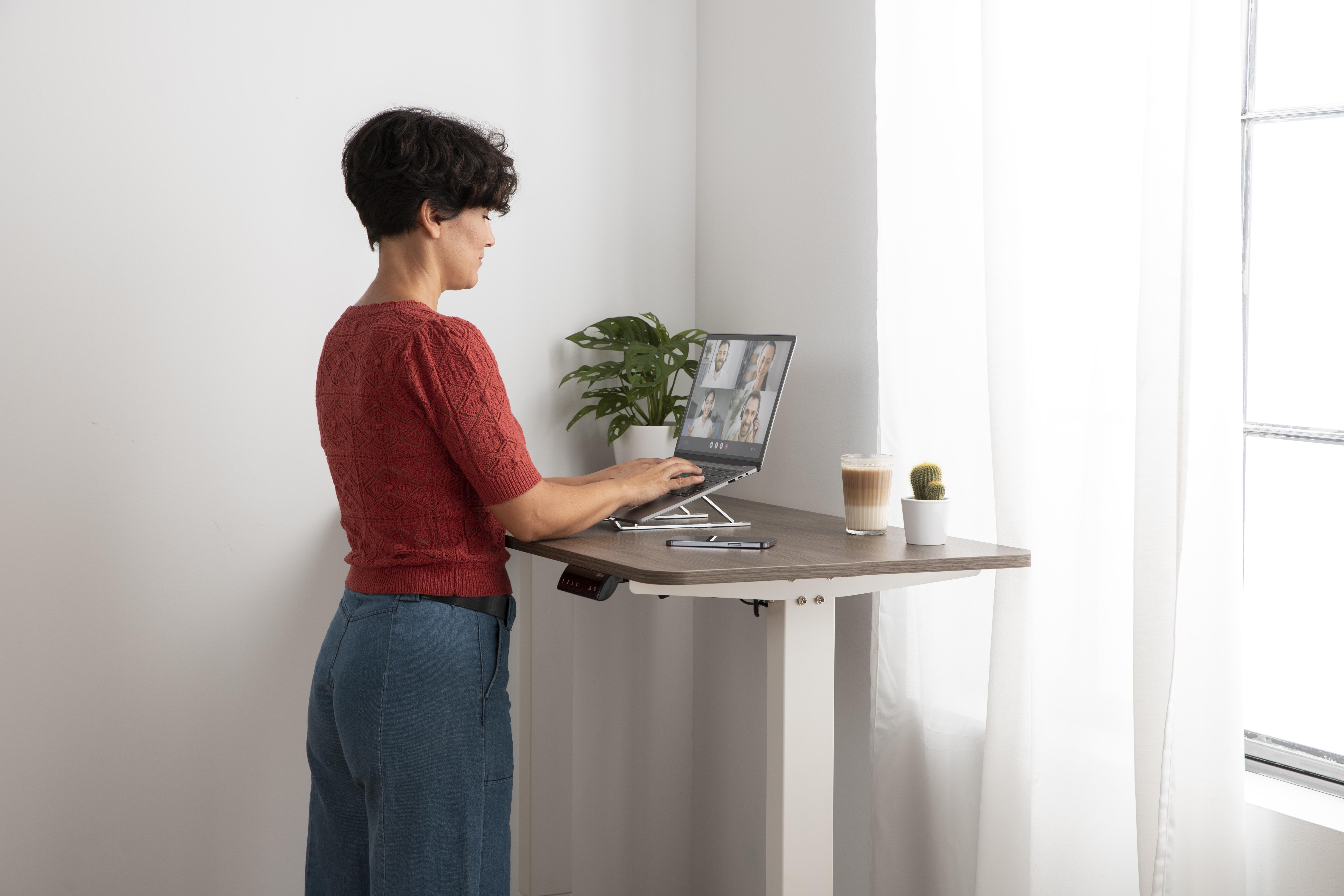
The structural change is visibility. In an office, a facilities team walks past a workstation. A manager notices someone rolling their shoulder. Equipment is standard issue and someone owns it. None of that survives the move to hybrid. The employer still carries the duty and the cost, but has lost every informal signal it used to rely on, and the setups are now unique to each household rather than standardised across a floor.
The population this affects is not marginal. ONS found 28% of working adults in Great Britain hybrid worked between January and March 2025, rising to 34% of full-time workers, 41% of those with a degree and 45% of those earning £50,000 or more. Hybrid working is concentrated among professional, higher-earning, desk-based staff, which for most enterprise employers means it is concentrated among the people who are most expensive to lose and most expensive to replace.
So the risk did not go up uniformly. It became harder to see, in precisely the group where the consequences cost most.
The duty follows the worker home
Employers sometimes treat home working as a grey area. It is not. The Health and Safety (Display Screen Equipment) Regulations 1992 apply to home workers in the same way as office-based staff: assess the workstation, reduce identified risks, provide training and information, and fund an eye test on request.
The compliance requirement is covered in more depth in our guide to workplace ergonomic health services and DSE compliance. For the purposes of this piece, the relevant point is that compliance sets the floor, not the ceiling. Meeting the duty tells you a process ran. It does not tell you anyone is in less pain.
The four layers hybrid MSK support needs
Assessment that works without anyone visiting. Ergonomic assessments for hybrid staff have to be self-serve and still produce something useful, which means adaptive questioning rather than a static form, and output specific enough that the person can act on it the same day.
Prevention people will actually do. The first-line response to most desk-related discomfort is behavioural: setup changes, movement, habit. This is where workplace injury prevention either happens or does not. Generic advice fails here, which is why personalisation is a functional requirement rather than a nice touch.
A route into treatment for the minority who need it. Most people can self-manage with the right guidance. A minority cannot, and for them every week of delay makes the outcome worse and the eventual cost higher. A programme without a treatment route just documents that minority.
Reporting that tells you what happened. Completion rates measure activity. You need risk by location and team, change over repeat assessments, and what happened to the cases that were flagged.
Remote employee health programmes tend to be strong on the first two layers and weak on the second two. That is usually what people mean when they say a wellbeing programme did not move anything.
Where VIDA fits
Vitrue Health's VIDA platform covers assessment, prevention and reporting directly, and connects to treatment through a clinical partnership.
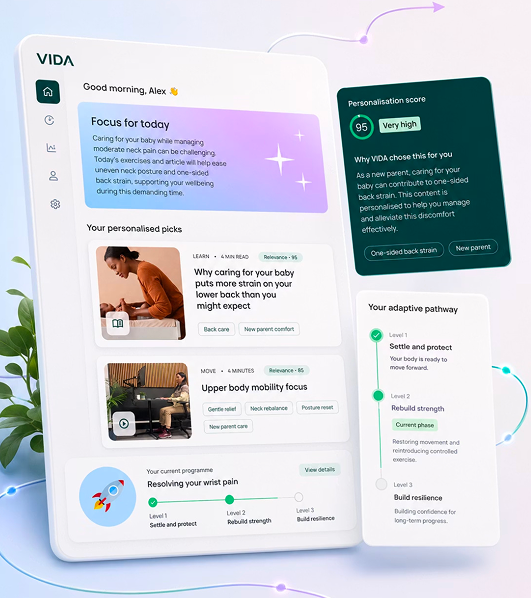
Assessment and prevention. VIDA runs interactive ergonomic assessments across office, home and hybrid workers. It identifies desk setup, screen, chair and posture issues, reported pain or discomfort, and working habits that may be contributing to symptoms, then produces recommendations specific to that person. The decisioning sits in Atlas, VIDA's content and decisioning system, under clinical ownership. The first-line response is behavioural, which is deliberate: it keeps the programme from turning into an equipment ordering process that raises cost without addressing cause.
Digital physiotherapy, as an option. Where self-management is not enough, VIDA can route into treatment. Through Vitrue Health's partnership with PhysioFast Online, employers can add a referral route to online physiotherapy delivered by HCPC-registered clinicians with at least five years' experience, with same-day appointments available. Two things worth being precise about. This is an option employers choose to enable rather than part of every VIDA deployment, and the clinical care is delivered by PhysioFast Online's clinicians, not by VIDA. VIDA's role is to identify who needs it and get them there with their assessment context attached.
Analytics for the people accountable. Admins see MSK risk and engagement across the workforce, filtered by team, location, region, business unit or worker type, which is what makes hybrid populations legible again. Access is scoped by role, and a restricted admin can review participation and aggregated risk without seeing individual results, which matters when HR, health and safety and occupational health each need a different view of the same people.
Escalation into your own pathway. Where an assessment suggests someone should be looked at, VIDA raises a "might need review" flag. That is a prompt to review in line with your process, not a clinical judgement and not an automatic equipment approval. Employers who already run occupational health or an ergonomist service can route into that instead.
VIDA was named Best Use of Technology for Benefits at the WSB Awards 2025, for work delivered in partnership with Bupa.
VIDA surfaces risk and routes people to appropriate support. It does not diagnose. Any projected savings from earlier intervention are modelled, not guaranteed, and depend on engagement and on how an organisation acts on what the assessment finds.
.png)
How to tell whether it is working
Six measures, in rough order of how much they tell you.
- Change in reported discomfort across repeat assessments. The only measure that speaks to the actual goal. Requires repeat assessment, so check the programme supports it before you buy.
- What happened to flagged cases. How many were raised, how many were reviewed, how many closed. An open flag is an unmanaged risk with a date on it.
- Proportion of people who acted on a recommendation. Distinguishes a programme people used from one they clicked through.
- Completion split by working location. An overall completion rate hides the home-working gap, which is usually where it sits.
- Referral volume and origin. Whether cases are reaching treatment through the programme or arriving late through occupational health and absence.
- Equipment spend per head. A behaviour-first programme should hold this down. If it is rising, the assessment is functioning as a procurement form.
Frequently asked questions
What are workplace musculoskeletal health services?
Workplace musculoskeletal health services are the assessments, guidance, clinical routing and reporting employers use to reduce MSK risk across a workforce. They typically combine ergonomic assessment, personalised prevention guidance, a route into treatment for people who need it, and analytics showing risk and engagement across teams and locations.
How do you run ergonomic assessments for remote and hybrid workers?
Through self-serve digital assessment rather than a site visit. The assessment needs to adapt to the person's answers rather than present a fixed checklist, produce recommendations specific to their setup and symptoms, and record the outcome for compliance purposes. Coverage should be the same for home, office and hybrid working, since the employer duty is the same.
Do employers have DSE duties for staff working from home?
Yes. The Health and Safety (Display Screen Equipment) Regulations 1992 apply to home workers in the same way as office-based staff. Employers must assess the workstation, reduce identified risks, provide training and information, and fund an eye test on request.
What is digital physiotherapy?
Digital physiotherapy is assessment and treatment delivered remotely by a qualified physiotherapist, usually by video appointment, with an exercise programme the person follows between sessions. For employers it shortens the wait between a problem being identified and treatment starting, which matters most for hybrid staff who are not near an on-site service.
How is MSK support different from a general employee wellness programme?
A general wellness programme is usually broad and self-directed. MSK support is targeted at a specific, measurable risk, and includes a clinical route for people whose symptoms need treatment rather than guidance. The practical difference is whether the programme can tell you what happened to the people it identified as at risk.
How do you measure whether workplace MSK support is working?
The strongest measure is change in reported discomfort across repeat assessments. Alongside it, track what happened to flagged cases, the proportion of people who acted on a recommendation, completion split by working location, referral volume and origin, and equipment spend per head.