
Key takeaways
- Workplace ergonomic health services cover the assessment, risk reduction and ongoing management of musculoskeletal risk for people working at screens.
- UK employers have a legal duty under the Health and Safety (Display Screen Equipment) Regulations 1992 to assess workstations, reduce risk, provide training, and fund an eye test on request.
- The duty applies to anyone using display screen equipment daily for continuous periods of an hour or more, including home workers, hot-deskers and mobile workers.
- Musculoskeletal disorders affected 511,000 workers in Great Britain in 2024/25 and accounted for 7.1 million lost working days (HSE, 2025). Upper limb or neck conditions made up 211,000 of those cases.
- 64% of assessed workers report discomfort in the back, neck or shoulder at the point of their VIDA assessment (Vitrue Health platform data, more than 20,000 desk-based workers).
- Compliance and health outcomes are usually run as separate processes. Treating them as one assessment is what turns a paperwork exercise into earlier intervention.
What are workplace ergonomic health services
Workplace ergonomic health services are the assessments, equipment decisions, training and clinical routing an employer uses to reduce musculoskeletal risk among desk-based staff. They typically cover four things: identifying who is at risk, correcting workstation setup, giving people guidance they will actually follow, and escalating the minority who need clinical input.
Most organisations buy them for one of two reasons. Either a compliance deadline is approaching, or absence and private medical insurance costs have started to move in the wrong direction. The two buying triggers lead to very different procurement conversations, which is why the market splits between form-led DSE tools and clinically-led MSK programmes.
What UK law requires under the DSE Regulations
The Health and Safety (Display Screen Equipment) Regulations 1992 place four specific duties on employers.
Carry out a DSE workstation assessment. Assess each user's workstation and act on what it finds. Reassess when the workstation, the equipment or the user's circumstances change.
Reduce risks. Ensure users take breaks from screen work or change activity, and correct the setup issues the assessment identifies.
Provide an eye test on request. Fund an eye and eyesight test when a DSE user asks for one, and contribute to corrective appliances where these are needed specifically for screen work.
Provide training and information. Users need to understand the risks and how to adjust their own setup, not just complete a form.
A DSE user is someone who uses display screen equipment daily for continuous periods of an hour or more. HSE is explicit that this includes home workers, hot-deskers and mobile workers, not only people at a fixed desk. For most enterprise employers, that means the assessed population is close to the whole office-based workforce.
Why DSE compliance and musculoskeletal health drift apart
Most DSE processes were designed to evidence compliance, not to reduce pain. The assessment produces a completion rate, the completion rate goes to the audit file, and the employee carries on working the way they did before.
The gap shows up in the national figures. In 2024/25, 511,000 workers in Great Britain reported a work-related musculoskeletal disorder, and MSDs accounted for 27% of all work-related ill health cases and 7.1 million lost working days (HSE, 2025). Upper limb or neck conditions, the pattern most associated with screen work, made up 211,000 of those cases.
It shows in our own assessment data too. 64% of assessed workers report discomfort in the back, neck or shoulder at the point of their VIDA assessment (Vitrue Health platform data, more than 20,000 desk-based workers).
Absence is also the wrong headline number. The larger cost sits in presenteeism, where people keep working in discomfort, productivity drops quietly, and the problem only becomes visible once it needs a referral. By that point the employer is paying for treatment rather than prevention, in a market where medical costs are rising faster than general inflation.
What a good ergonomic assessment should produce
A completion rate is an input, not an outcome. An assessment is doing its job when it produces four things.
- A risk picture, not just a form. Which teams, sites and job roles carry the most risk, and how that has changed since the last cycle.
- Personalised guidance the employee can act on that day. Generic advice is ignored. Specific, setup-relevant recommendations are not.
- A defensible audit trail. Assessment date, findings, actions taken, and evidence of follow-up, held in one place rather than across spreadsheets and email.
- A clear escalation pathway. A route for the small proportion of people whose answers indicate they need review, with defined ownership on the employer side.
The fourth point is the one most commonly missing. Without it, an assessment identifies risk and then does nothing with it.
How to choose workplace ergonomic health services
Six questions separate providers quickly.
- Does it cover home and hybrid working properly? The legal duty does not stop at the office door, and the assessment should not either.
- Is the clinical logic explainable? You should be able to see why a given answer produced a given recommendation, and who is clinically accountable for it.
- What is the administrative burden per site? Ask specifically what local HR or facilities teams have to do each cycle. This is where most programmes quietly fail.
- Does it integrate with your identity and HR stack? SSO and automated provisioning decide whether the programme runs itself or becomes a manual chase.
- What reporting do governance and audit actually get? Board-level MSK risk reporting is a different output from a completion spreadsheet.
- Does it route people onward? Assessment without escalation leaves the risk where it was found.
Where VIDA fits
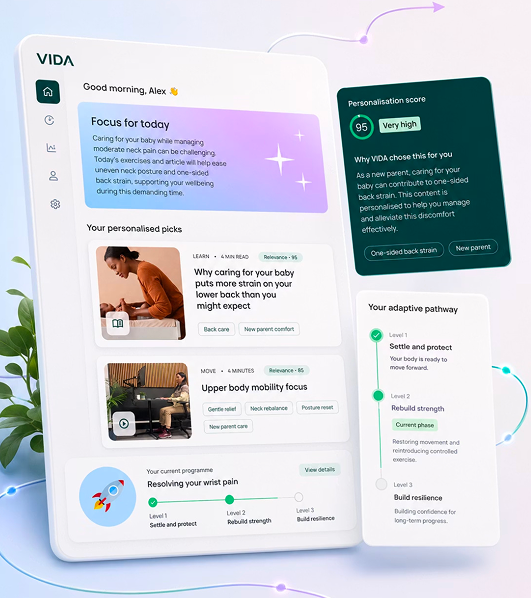
Vitrue Health's VIDA platform was built to do the compliance job and the health job in the same assessment, rather than running them as two processes.
Less to administer. VIDA automates the parts of the cycle that normally absorb a health and safety team: invitations, reminders and follow-up, with completion tracked live rather than reconciled from a spreadsheet. Provisioning runs through SSO, SCIM and HRIS integration, so joiners, movers and leavers are handled in the source system rather than maintained by hand. What stays with the employer is the part that should, deciding what happens to the cases the assessment surfaces.
Clinically led rather than form led. The assessment is interactive, not a checklist. It identifies desk setup, screen, chair and posture issues, reported pain or discomfort, and working habits that may be contributing to symptoms, then produces recommendations specific to that person. The decisioning behind those recommendations sits in Atlas, VIDA's content and decisioning system, under clinical ownership. The first-line response is behavioural, covering setup changes, movement and habit prompts. That is deliberate, because it stops DSE becoming an equipment ordering process that raises cost without addressing cause.
Analytics built for governance, not just completion. Admins see MSK risk and engagement across the workforce, filtered by team, location, region, business unit or worker type. Access is scoped by role, and a restricted admin can review participation and aggregated risk without seeing individual results. That matters when HR, health and safety and occupational health each need a different view of the same population.
Escalation into your pathway, not around it. Where an assessment suggests someone should be looked at, VIDA raises a "might need review" flag. That is a prompt to review in line with your process, not a clinical judgement and not an automatic equipment approval. From there VIDA signposts into whatever the organisation already uses, whether that is internal health and safety review, an ergonomist, occupational health or physiotherapy.
VIDA surfaces risk and routes people to appropriate support. It does not diagnose, and it does not replace clinical judgement or the oversight of a competent person where your process requires one.
Any projected savings from earlier intervention are modelled, not guaranteed, and depend on engagement rates and how an organisation acts on what the assessment finds.
What the first 90 days usually look like
Enterprise rollouts tend to follow a similar sequence. Weeks one to two are technical: SSO, provisioning and the population you are assessing. Weeks three to six cover governance, escalation ownership and the internal communications that determine engagement. From week six the assessments run, and the first meaningful risk reporting is usually available by the end of the first full cycle.
The variable that matters most is not the technology. It is whether someone internally owns the escalation pathway before the first assessment goes out.
Frequently asked questions
What is a DSE assessment?
A DSE assessment is an employer's review of a worker's display screen equipment workstation, required under the Health and Safety (Display Screen Equipment) Regulations 1992. It examines the screen, keyboard, chair, desk, posture and working environment, identifies risks, and records the actions taken to reduce them.
Who counts as a DSE user?
Anyone who uses display screen equipment daily for continuous periods of an hour or more. HSE guidance covers fixed workstations, home workers, hot-deskers and mobile workers. People who use screens only briefly or infrequently are outside the definition.
Do DSE regulations apply to employees working from home?
Yes. The duties apply to home workers in the same way as office-based staff. Employers still need to assess the workstation, reduce identified risks, provide training and information, and fund an eye test on request.
How often should DSE assessments be repeated?
There is no fixed statutory interval. Assessments should be reviewed when the workstation changes, the equipment changes, the user's circumstances change, or there is reason to believe the original assessment is no longer valid. Many employers run an annual cycle to stay ahead of these triggers.
What is the difference between DSE compliance and workplace ergonomic health services?
DSE compliance is the legal minimum: assess, reduce risk, train, and provide eye tests. Workplace ergonomic health services extend this into prevention, covering musculoskeletal risk identification, personalised guidance and clinical escalation. Compliance evidences that a process ran. Ergonomic health services aim to change the outcome.
How much do musculoskeletal disorders cost UK employers?
HSE recorded 511,000 workers with a work-related musculoskeletal disorder in Great Britain in 2024/25, and 7.1 million working days lost. The wider cost is larger than absence alone, because it includes presenteeism, private medical spend and the productivity loss from people continuing to work in discomfort.