
Why the gap between your back and the chair matters and how to close it

Nicola Tik
Most office chairs are designed with a backrest that curves inward to support the lower back. In theory this means sitting back in the chair should provide automatic support. In practice many people find that the backrest does not meet their lower back at all, leaving a gap between the chair and the curve of the spine that the lower back muscles have to bridge on their own. Over the course of a working day that sustained muscular effort adds up into the familiar aching and stiffness that many desk workers experience by mid-afternoon, whether or not they have an existing back condition.
The gap between the lower back and the chair backrest appears for a few common reasons. The lumbar support may be fixed at a height that does not correspond to where the individual's lower back curve actually sits, or the chair may have no meaningful lumbar support at all. Seat depth is another factor: a seat that is too deep forces a choice between sitting back with the legs dangling uncomfortably, or sitting at a comfortable leg position with the back unsupported.
But the most common reason the backrest fails has nothing to do with the chair itself. Many people simply do not sit back against it. Concentration pulls the body forward towards the screen, and the backrest that was providing support at the start of the session is no longer in contact with the back an hour later, without the person noticing.
The lumbar curve of the lower back is not a design flaw. It is the spine's natural load-bearing shape, and maintaining it during sitting is what allows the discs, joints, and muscles of the lower back to share the load of an upright position efficiently. When the curve is not supported and begins to flatten or reverse, as it tends to do during prolonged unsupported sitting, the muscles of the lower back have to work continuously to prevent the spine from collapsing further into flexion.
This sustained low-level muscular effort is not immediately painful but it is tiring, and it is one of the primary reasons that the lower back feels progressively worse through a long day of desk work. For people who already have lower back discomfort, unsupported sitting tends to bring symptoms on sooner and make them more pronounced than they would be in a well-supported position.
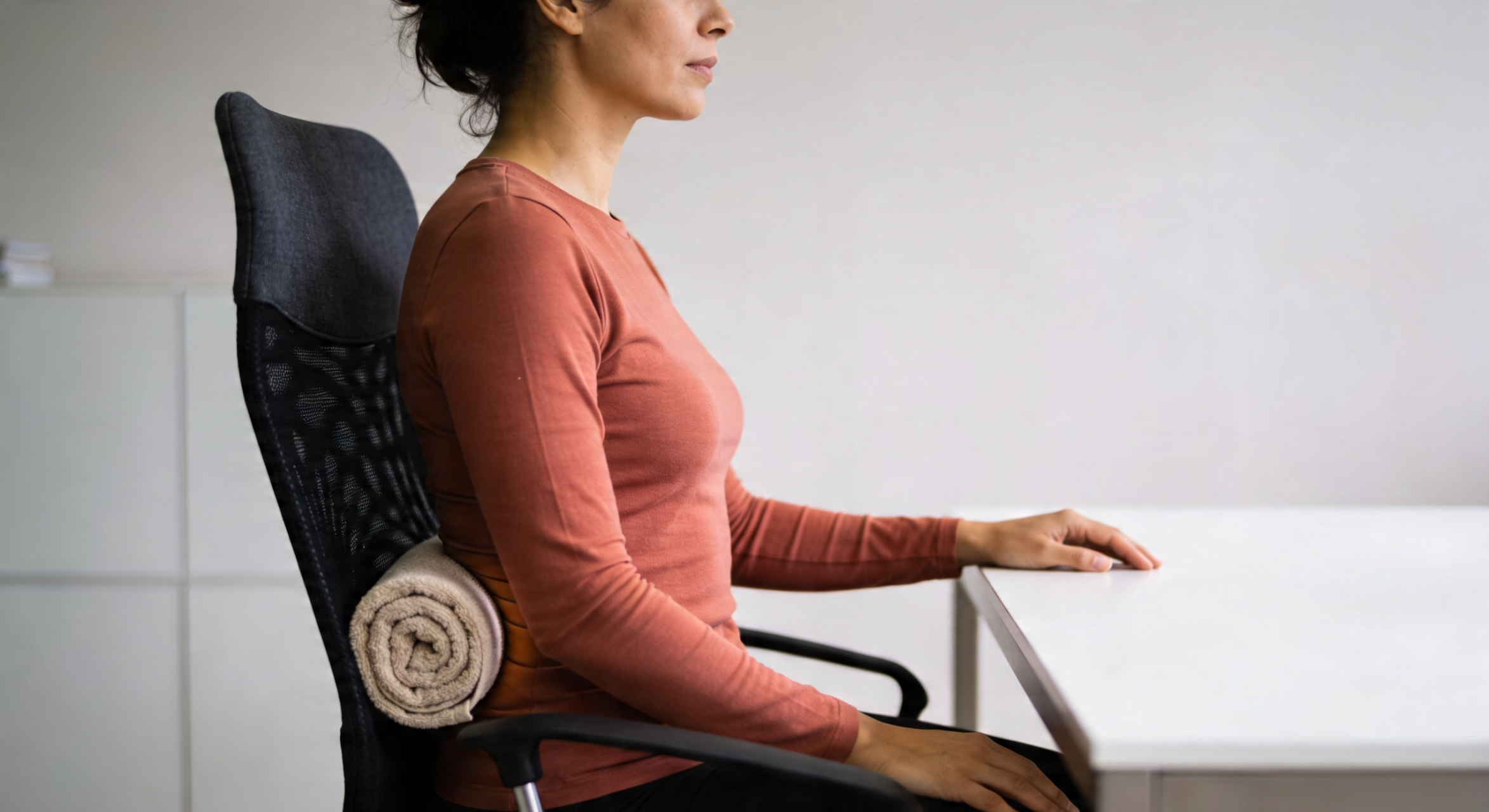
The most direct fix is to bring support to the lower back rather than waiting for the chair to provide it. A rolled towel, a small firm cushion, or a dedicated lumbar support placed in the curve of the lower back and held between the back and the chair backrest fills the gap immediately and maintains the lumbar curve without any muscular effort required to hold it.
The support should sit in the curve of the lower back, roughly at waist height, rather than in the middle of the back or lower down towards the seat. Too high and it pushes the upper back forward. Too low and it misses the curve entirely. A minute of adjustment to find the right position is worth the effort because the difference in how the lower back feels across a full day is significant.
If the seat depth is the issue, the most practical fix is to place a firm cushion or folded jacket behind the lower back, which effectively shortens the seat depth by bringing the back forward relative to the seat. This allows the legs to sit comfortably without sacrificing contact with the backrest.
For people with existing lower back discomfort, chair support is particularly important because the lower back is already sensitised and less able to manage the additional demand of unsupported sitting. The same fixes apply, but the difference they make tends to be more immediately noticeable.
Keeping gently active through the day, as covered in the lower back pain articles in this series, remains the most important factor in managing lower back symptoms. Chair support makes the periods of sitting more comfortable and less likely to worsen symptoms, but it works best alongside regular movement rather than as a substitute for it.
Your VIDA plan includes exercises and stretches for the lower back designed to build the strength and mobility that supports comfortable sitting over time. Following them regularly alongside the setup adjustments covered here gives the lower back the best conditions for feeling and functioning well through a working day.