Making yoga or Pilates work for your body

Dr Nicola Tik
Maybe a colleague talked you into a lunchtime class, or you have been following videos at home for a while. Some poses feel wonderful, but others leave your wrists sore, your knees uncomfortable or your hamstrings complaining. The good news is that yoga and Pilates are endlessly adaptable, and a few simple swaps can help make them work for you.
Every body is built a little differently. The length of your limbs, the shape of your joints and how flexible you naturally are all affect how a pose feels. A position that looks effortless on one person can feel completely different on another.
Yoga is generally very safe. A review of 94 trials, including more than 8,000 people, found it was no more likely to cause problems than other forms of exercise. In a large survey of people who practise yoga, injuries worked out at roughly one for every 1,700 hours of practice. Most problems that do happen involve muscles and joints being pushed further than they are ready to go. That is why adapting poses to suit your body matters so much.
Props are not a sign that you are doing it wrong. They bring the floor closer to you, support your joints and help you find the shape of a pose without forcing it.
Some options to try:
Poses like downward dog and plank put a lot of weight through your wrists, especially if you are not used to it. A few changes can help.
You could try spreading your fingers wide and pressing through your knuckles and fingertips, rather than sinking into the heel of your hand. Coming down onto your forearms in plank or downward dog takes your wrists out of the picture altogether. Placing a rolled-up edge of your mat under the heels of your hands can also ease the bend in your wrist.
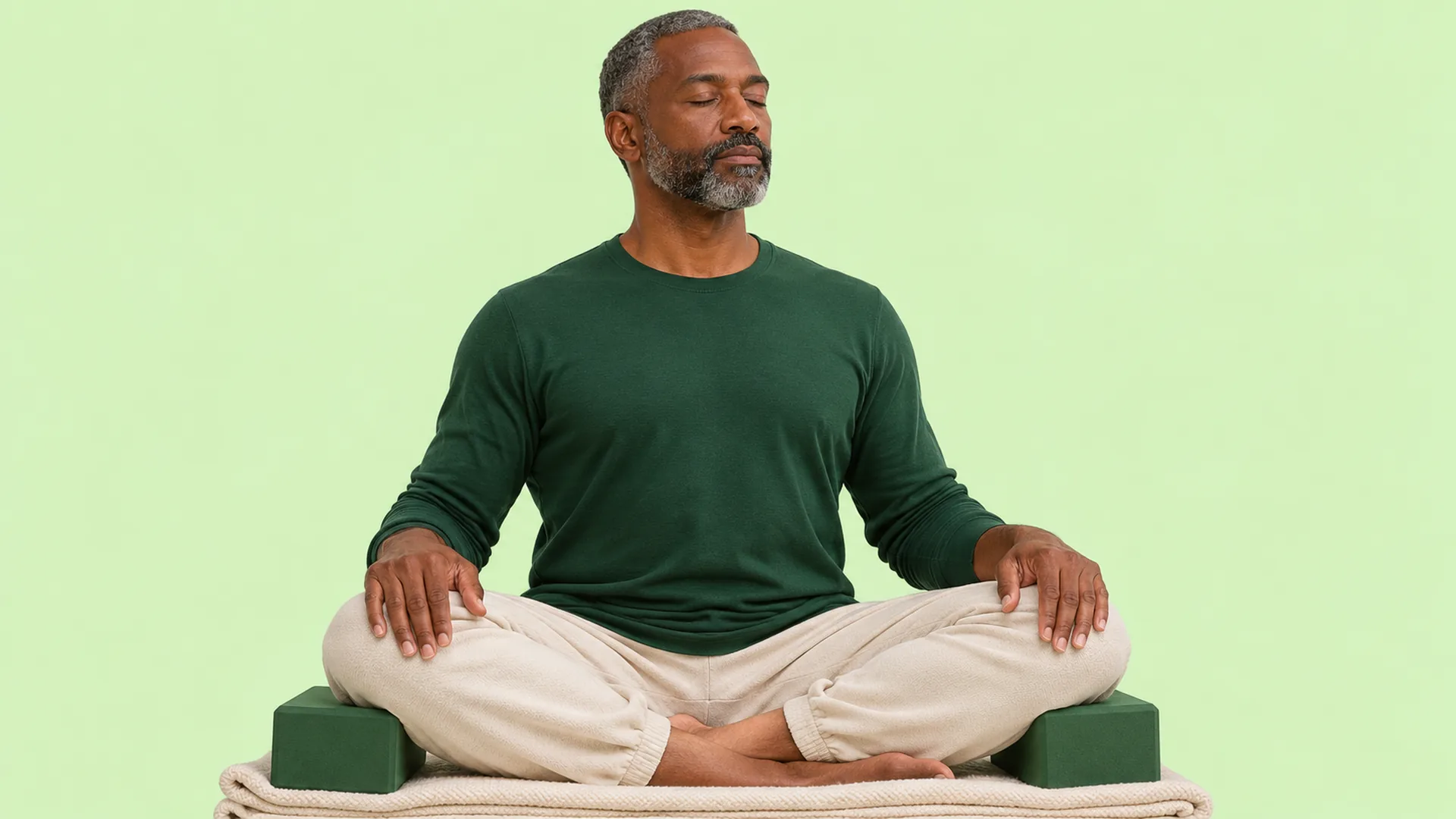
Kneeling and cross-legged poses can be tough on your knees. A folded blanket under your knees adds cushioning. In cross-legged positions, sitting on a cushion and supporting your knees with blocks reduces the strain.
Deep cross-legged poses like lotus place a lot of twisting force on the knee. It is fine to skip them or choose a simpler cross-legged position. If a pose twists your knee uncomfortably, there is almost always an alternative that works the same area in a different way.
Tight hamstrings, the muscles at the back of your thighs, are common, especially if you sit for much of the day. In forward bends, bending your knees as much as you need to lets you fold from your hips without pulling on the backs of your legs. Over time, many people find they can straighten their legs a little more as their flexibility improves.
The right class makes a real difference. In the large yoga survey, people who practised only on their own, without a teacher, were more likely to report problems. Something to look for is a beginner or gentle class, a teacher who offers options for different bodies, and a class size where the teacher can see what you are doing.
It is also fine to tell your teacher about anything that tends to bother you. A good teacher will welcome it and suggest alternatives.