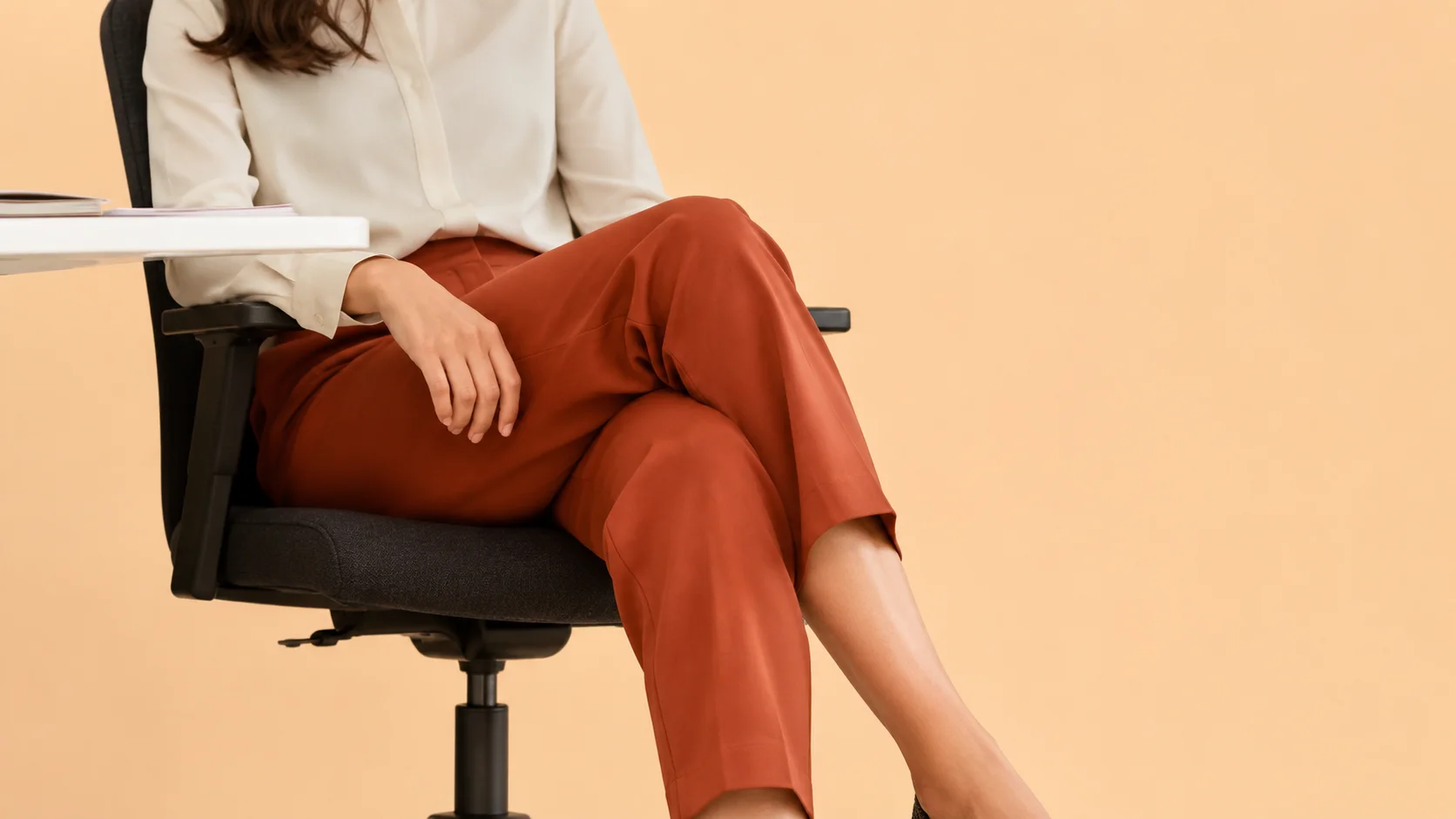
Is crossing your legs at your desk actually bad?

Nicola Tik
At some point most of us have been told that crossing our legs is bad for us. So if you catch yourself doing it without thinking, halfway through the afternoon at your desk, you might wonder whether you are quietly storing up trouble. The honest answer is a good deal more relaxed than the warnings suggest, and it is worth knowing what is really going on.
For most people, crossing your legs is not something to worry about. Your body is perfectly happy to sit in all sorts of shapes, and this is just one of them. What actually matters is not holding any single position, crossed or not, for hours on end. So the crossing is not the problem. Staying frozen in it is, in exactly the same way that sitting rigidly upright for hours would be. That is a much kinder thing to keep in mind than never daring to cross your legs again.
A couple of the common warnings do not really hold up. There is no good evidence that crossing legs causes varicose veins, and there is no good evidence that it damages your posture or bends your spine over time. Those claims have been repeated for years, but they are largely overblown. You can let go of the idea that a comfortable sit is doing you lasting harm.
A few real things do happen, and they are quite interesting. Crossing at the knee nudges your blood pressure up a little while you hold it, which is exactly why you are asked not to cross your legs when someone takes a reading. It settles again the moment you uncross. It also tips your pelvis and gently twists your spine to one side. None of that does any harm in a normal spell of sitting, it is simply your body doing what the position asks.
If your foot or lower leg starts to tingle or feels like it has gone to sleep, that is usually because crossing at the knee has pressed on a nerve that runs near the top of your shin. It sounds alarming but it is not damage. It is your body's built-in nudge to shift position, and the feeling clears quickly once you uncross and move.
You do not need to ban it. Cross your legs if it is comfortable, just do not settle in that way for the whole afternoon. Swapping sides now and then keeps you from always loading the same one, and uncrossing to change position every so often covers the rest. If your leg starts to tingle, take it as the cue it is and move. As with most things when sitting, variety is the whole trick.