How to adapt your exercise routine during pregnancy

Nicola Tik
If exercise is already a regular part of your life, pregnancy brings a particular kind of challenge. It is not just about what your body can do, it is about adjusting your relationship with movement when the goalposts keep shifting. This article is for people who are used to being active and are working out how to stay that way in a way that works for pregnancy.
Being active going into pregnancy is genuinely beneficial. Good cardiovascular fitness, muscle strength, and body awareness all support your body as it adapts to the demands of pregnancy. The goal is not to scale everything back dramatically, it is to make thoughtful adjustments that keep you moving safely and comfortably as your body changes.
Most people who exercise regularly can continue doing so throughout pregnancy, with some modifications along the way. The adjustments tend to be gradual rather than sudden, and many feel intuitive once you know what to look out for.
In the first trimester, fatigue and nausea may be the biggest factors affecting your training rather than physical limitations. On days when energy is low, shorter or gentler sessions are a completely reasonable response. Maintaining the habit of movement matters more than maintaining intensity at this stage.
From the second trimester, your changing centre of gravity and growing bump start to have a more direct effect on how you move. Exercises that require significant balance, sharp changes of direction, or a strong stable core may start to feel less comfortable and will benefit from modification. This is also the point at which lying flat on your back for extended periods during exercise is worth avoiding, as this position can place pressure on a major blood vessel. Most exercises can be adapted to a seated, standing, or side-lying position without losing their value.
By the third trimester, the focus shifts naturally towards maintaining activity rather than pushing performance. Load management, the way you distribute demand across your body during exercise, becomes more important as the weight and postural shift of late pregnancy increases the demand on your joints and muscles. Keeping sessions comfortable and responsive to how you feel on a given day tends to work better than following a fixed programme.
Running can often continue well into pregnancy for people who were running regularly beforehand, though pace and distance naturally tend to reduce as pregnancy progresses. Paying attention to how your pelvis and hips feel during and after a run is useful, as increased ligament laxity can make these areas more sensitive to impact over time.
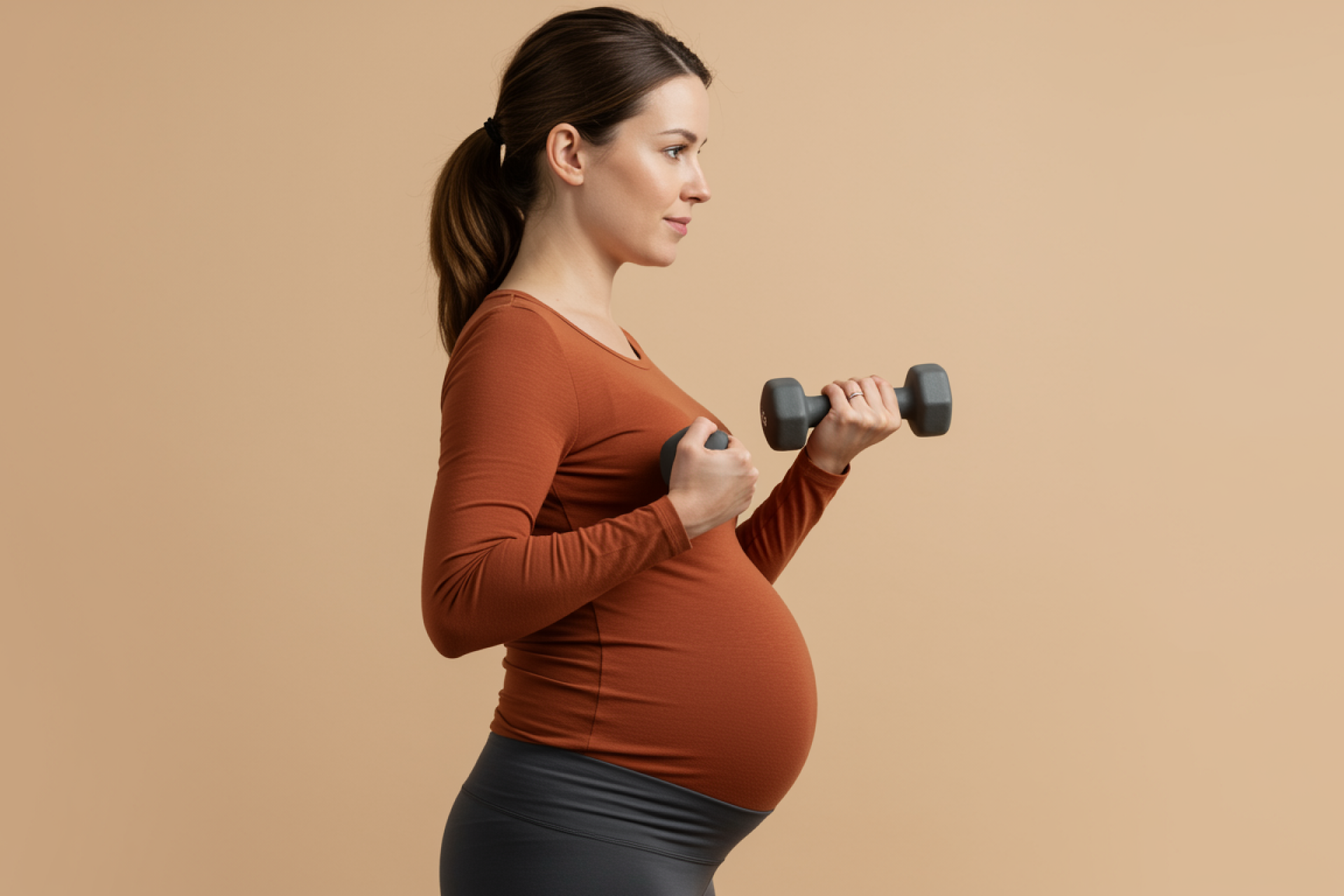
Strength training adapts well to pregnancy with some adjustments. Keeping loads at a level that feels controlled and comfortable, avoiding exercises that place direct pressure on the abdomen, and modifying positions that require lying flat are the main things to be mindful of. The principle is maintaining strength rather than building it.
Cycling, whether outdoor or stationary, tends to suit pregnancy well. A stationary bike becomes a more practical option later in pregnancy when balance and the risk of falling make outdoor cycling less comfortable.
High-intensity and impact-based exercise can often continue in modified form in the earlier trimesters, but most people find they naturally reduce intensity as pregnancy progresses. Following that instinct is a sensible response to what your body is telling you.
There will be days, and sometimes longer periods, when your body simply does not want to train the way it usually does. This is normal and does not reflect a loss of fitness or commitment. Pregnancy places significant demand on the body independently of exercise, and on days when that demand is high, rest is a completely valid and useful response.
Reframing rest as part of your active approach rather than an interruption to it tends to make this easier to sit with. Your body is doing something significant. Working with it rather than against it is not a step back, it is good training instinct.