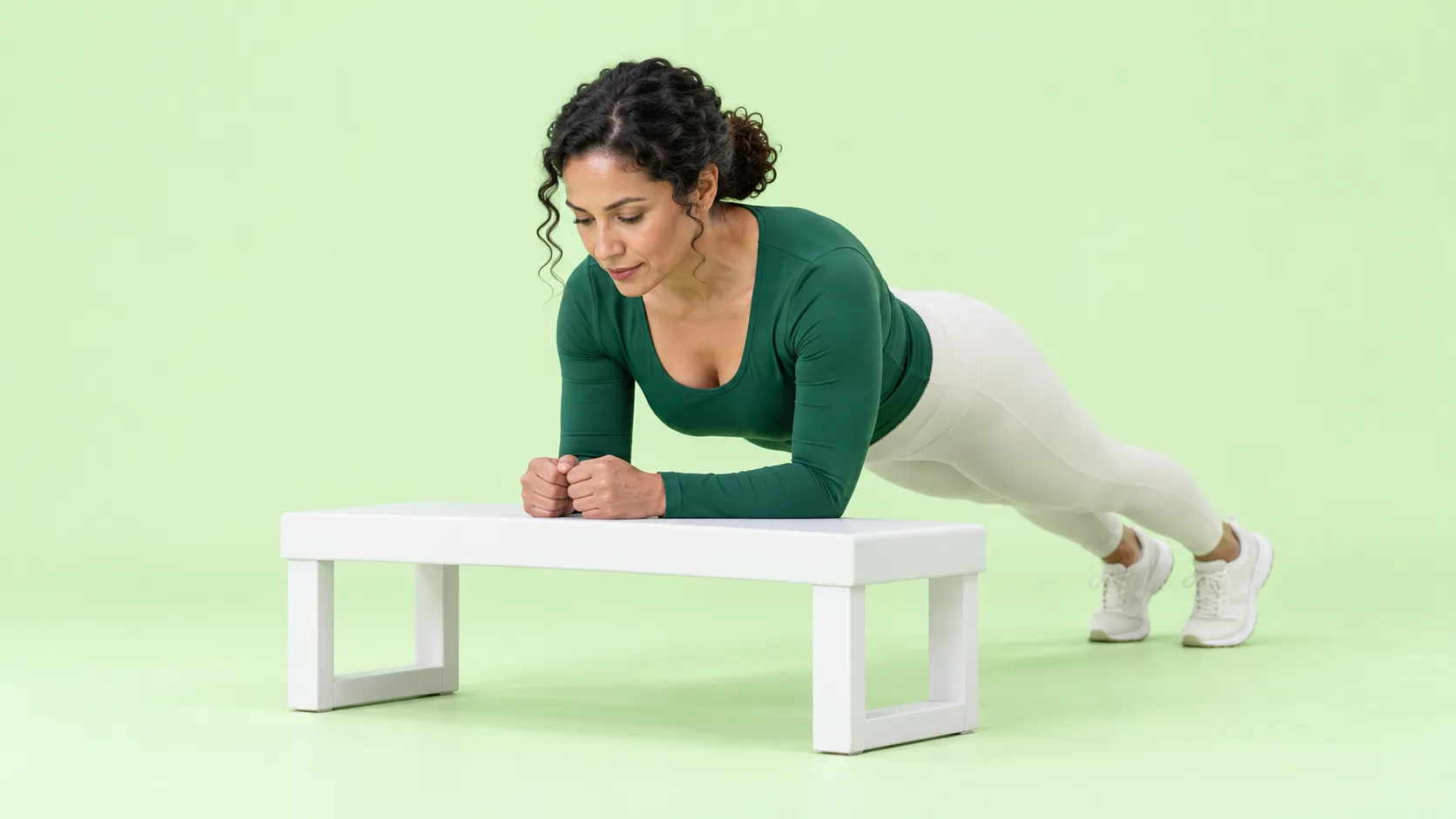
Goal: Hold a steady plank
Choosing the right plank version for you

Dr Nicola Tik
Once you can hold a forearm plank for 30 seconds or more, it’s natural to wonder whether you should always be on your toes. You don’t have to. Choosing the right version for the day is one of the most useful skills you can build, and it’s how people keep improving without stalling.
The main difference between plank versions is how much of your body weight your arms and trunk have to hold. Research on push-up positions found that going onto your knees takes around 15% of your body weight off your arms. A forearm plank isn’t exactly the same, but the same principle applies. A forearm plank on your knees is a lighter load than one on your toes, and raising your forearms onto a sturdy step or bench lightens it further.
So moving between versions isn’t going backwards. It’s adjusting the load, the same way you’d choose a lighter or heavier weight in a gym.
A good rule of thumb is to choose the version where you can hold good form for most of the hold. If your shape slips within a few seconds, the load is too heavy for today. If you can hold perfectly still without any shaking, you may be ready for something harder.
You don’t have to pick just one. Many people find it helps to start each session with forearm planks on their toes while they’re fresh, then switch to their knees once their form starts to fade. That way you keep training with good form for longer.
The video shows easier and harder versions alongside each other, so you can switch at any point without stopping. Choosing the version that suits you on the day is part of the plan, not a step backwards.
In each session, you could start on your toes, then switch to your knees as soon as your hips begin to drop. Notice how many more good-form seconds you get across the session.